Growing up in the lively neighbourhood of Aya Nagar in South Delhi, Mansi Lodhi was always immersed in a tapestry of cultures and communities. From a co-ed elementary school to an all-girls high school, her world was shaped by the warmth of people constantly woven into each other's lives. When she enrolled in a pharmacy programme at a small college, however, something felt quietly misaligned. Her real passions — psychology, storytelling, and the invisible threads connecting communication and the human mind — were pulling her elsewhere.
It was in her writing and English classes that something shifted. Meeting published writers, she realised a profound truth: you don't need a formal degree to pursue the things you love and are genuinely good at.
A door she didn't know existed
After her first year of undergraduate study, Mansi came across the Community College Initiative (CCI) Program through Learning by Local, a Delhi-based educational non-profit founded by CCI alumnus Pradeep Kumar. The opportunity was unlike anything she had encountered before — a fully-funded exchange programme that would take her 15 miles from Washington, D.C., to Northern Virginia Community College (NOVA).
She applied. She got in. And just like that, the streets of Aya Nagar gave way to the highways of Northern Virginia.
The loneliness of wide-open spaces
Mansi arrived in the United States brimming with excitement. She embraced the individuality and freedom she saw in her peers. The diversity felt familiar — people from every corner of the world, much like the mosaic she had grown up in. But there was one thing she hadn't anticipated: silence.
"I thought living in the U.S. would be really easy. I knew that living conditions in America are better than India, but I got to know that there are other challenges — like having a sense of community. In India, even neighbours and friends of friends want to get involved in your life. In the U.S., people protect their personal space and will only ask you about personal things if you offer to share."
— Mansi LodhiComing from a culture where community is an ever-present, uninvited, and deeply welcome guest, Mansi found American individualism both fascinating and isolating. The neighbour who didn't knock, the colleague who didn't pry — it took adjustment. But she adapted, the way curious people always do.
Community, rebuilt one connection at a time
Mansi threw herself into campus life. Her internship at the AAPI (Asian American and Pacific Islander) Centre became an unexpected anchor. Surrounded by peers from across Asia, she discovered something remarkable: beneath the differences of language, country, and custom, there was a common emotional grammar — shared experiences that needed no translation. The AAPI lounge became a home away from home.
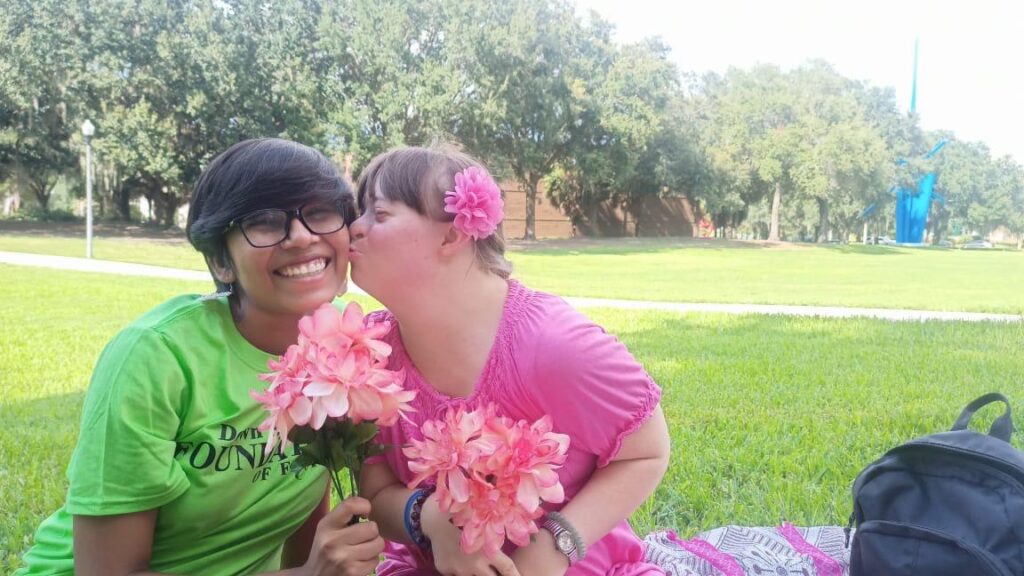
It was also through her programme's mandatory volunteering requirement that Mansi found one of her most unexpected joys. She had assumed volunteering was something students did reluctantly, a box to check. What she found instead was a window into American civic life.
A moment that changed her perspective: While volunteering in the President's Garden in Washington, D.C., Mansi found herself working alongside corporate directors, non-profit workers, and everyday citizens — all choosing to give their time. It quietly dismantled her assumptions about who volunteers and why.
"Volunteering builds community," she reflected. In India, social norms can make such visible participation feel unusual. But Mansi saw, firsthand, how a robust culture of service weaves people, organisations, and government into something cohesive and reciprocal.
Her community impact project: giving things a second life
Mansi was struck by how much waste America produces — and how much of it could be avoided. For her Community Impact Project (CIP), she designed a simple but meaningful initiative at NOVA: collecting belongings from departing CCI students — clothes, books, electrical appliances, and more — and redistributing them to incoming students who need them most.
The idea is elegant in its practicality. Students leave items behind not out of carelessness but out of necessity. Mansi saw a way to turn that inevitability into generosity — building a small culture of reuse and mutual support on campus, one donated kettle or textbook at a time.
Seeing India through American eyes
One of the most unexpected gifts of the CCI Programme was the mirror it held up to Mansi's own culture. Studying media and communication at NOVA, she learned that musical sequences in films — an absolute staple of Indian cinema — are often received very differently by American audiences. What is emotionally resonant and culturally natural in one context can feel jarring in another.
For Mansi, who dreams of becoming a screenwriter, this wasn't a deflating realisation — it was electrifying. Understanding how culture shapes narrative, form, and audience perception is exactly the kind of knowledge that makes storytellers better at their craft.
Advice from someone who's been there
"You should know what you actually want. You will get distracted a lot being in America — everyone wants to come here, and it's easy to lose sight of your goals. You should have a strong sense of responsibility to achieve them."
— Mansi LodhiIt's advice that sounds simple, but carries the weight of lived experience. An exchange programme is, at its best, gloriously overwhelming. The temptation to absorb everything — every experience, every detour — is real and understandable. Mansi learned to hold that openness alongside a steady sense of purpose.
Returning home, changed
When Mansi returns to India, she plans to continue her education — likely in social psychology, a field she believes will serve her well in the non-profit sector and sharpen the communication and networking skills she's been quietly building throughout her exchange year. And through all of it, she intends to write: stories, characters, and narratives that explore women's lives and the complex social worlds they navigate.
Mansi's journey is, at its core, a story about what happens when you step beyond the familiar — not just geographically, but intellectually and emotionally. She left Delhi a curious young woman with interests that didn't quite fit her chosen path. She returns with a clearer sense of who she is, what she values, and what she wants to build.
That, perhaps, is the truest measure of an exchange programme's success.